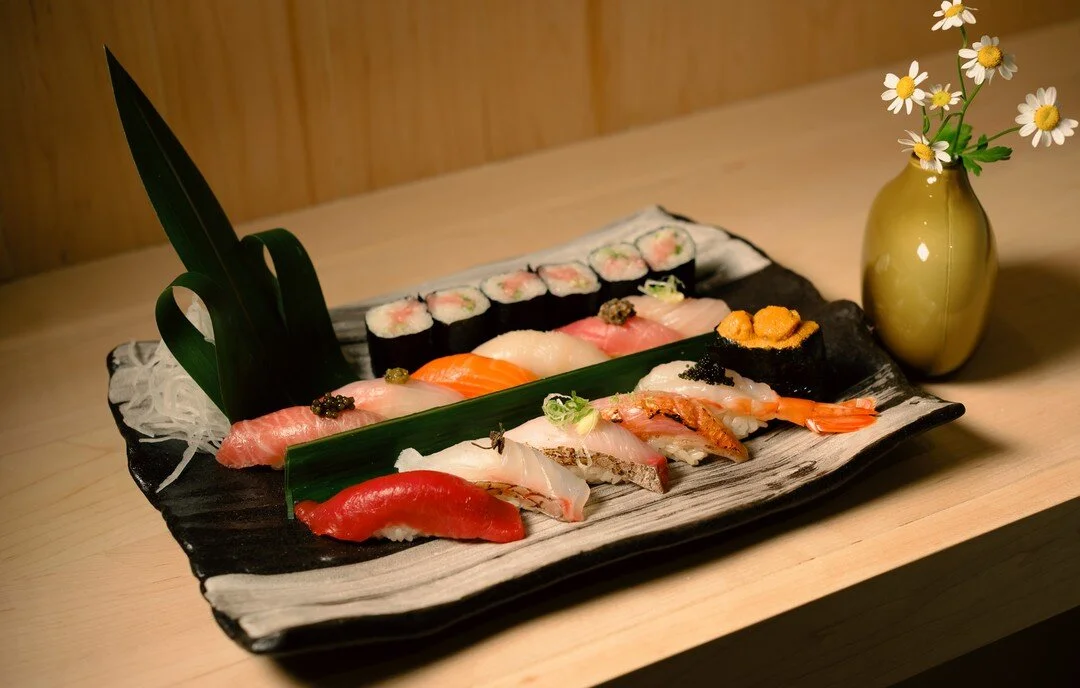
Most people believe that the freshest fish makes the best sushi. It’s an intuitive assumption — and for centuries, even in Japan, the ideal was fish so fresh it was still moving. But Japanese sushi masters discovered something counterintuitive long ago: for many species, controlled aging unlocks deeper, more complex flavors that fresh fish simply cannot achieve.
At Atto Sushi, dry-aging is not a trend or a marketing angle. It’s a discipline rooted in the Edomae tradition of Tokyo’s sushi counters, refined with modern understanding of food science. Here’s what actually happens when fish is aged — and why it matters for the sushi on your plate.
The Biochemistry: ATP to Inosinic Acid
The key to understanding dry-aged fish begins with a molecule called adenosine triphosphate (ATP) — the energy currency of all living cells. While a fish is alive, its muscles are rich with ATP. The moment the fish dies, a cascade of biochemical changes begins.
ATP doesn’t simply disappear. It breaks down through a specific pathway:
- ATP → ADP → AMP → IMP (inosinic acid)
Inosinic acid (IMP) is one of the most important umami compounds in food science. It’s the molecule responsible for the deep, savory flavor that distinguishes aged fish from fresh. When IMP combines with glutamate — another amino acid released during aging — the umami effect doesn’t just add up; it multiplies. Food scientists call this umami synergy, and it’s why properly aged fish has a flavor intensity that fresh fish cannot match.
The critical detail: IMP peaks at different times for different species. For some fish, peak IMP arrives within 24 hours. For others, it takes a week or more. A chef who ages fish must know these timelines intimately.
Protein Breakdown and Texture
While ATP is converting to IMP, another process is happening in parallel: autolysis, the self-digestion of proteins by the fish’s own enzymes.
Immediately after death, fish enters rigor mortis — the muscles stiffen as proteins lock together. Fresh-caught fish in rigor mortis has a firm, almost crunchy texture. Many people associate this texture with freshness, but it’s actually a sign that the fish hasn’t yet developed its full flavor potential.
As rigor mortis resolves and autolysis proceeds, proteins break down into free amino acids — including glutamate, the other major umami compound. The texture softens from rigid to supple, developing a silky, yielding quality that melts on the tongue. This is the texture that sushi connoisseurs describe as “neta ga neteiru” — the fish is resting, ready.
Go too far, however, and autolysis becomes decomposition. The texture turns mushy, off-flavors develop, and the fish is ruined. This is why aging fish is a craft that requires daily monitoring and expert judgment.
The Dry-Aging Process at Atto Sushi
Our approach to dry-aging combines traditional Edomae principles with precise modern controls:
- Temperature control: Fish is aged in specialized refrigeration units maintained at precise temperatures. Even a degree of variation can accelerate or delay the aging process unpredictably.
- Daily monitoring: Our chef inspects every piece of aging fish daily, checking texture by touch, aroma, and visual cues. There is no timer or formula that replaces this hands-on assessment.
- Individual treatment: Every fish is unique. Two pieces of the same species, from the same catch, may reach peak flavor on different days. The chef treats each one individually.
- Selective aging: Not all fish should be aged. Some species — particularly certain shellfish and very lean fish — are best served fresh. Knowing what to age and what to serve immediately is itself a form of expertise.
Which Fish Benefit from Aging?
Different species respond to aging in distinct ways:
White Fish (3–7 days)
Hirame (fluke), tai (sea bream), and kinmedai (golden eye snapper) develop a subtle sweetness and refined umami over several days. The texture becomes silky without losing its delicate structure. Kinmedai, in particular, transforms dramatically — from a mild, somewhat unremarkable flavor when fresh to a rich, complex taste after five days of aging.
Tuna (5–10 days)
Maguro, chutoro, and otoro are perhaps the most rewarding fish to age. The deep red flesh of bluefin tuna develops extraordinary depth over a week or more. The fat in otoro becomes even more luscious, while the lean maguro gains an almost beefy intensity. This is why our bluefin, sourced from Aomori Prefecture, is aged for five to seven days before it reaches your plate.
Traditional Edomae Fish (1–3 days)
Aji (horse mackerel), kohada (gizzard shad), and other traditional Edomae fish follow the shortest aging timeline. These species were the original subjects of Edo-period aging techniques, when sushi chefs in Tokyo developed methods to preserve and enhance their catch. Even one to two days of aging can meaningfully improve flavor.
The Edomae Connection
Dry-aging didn’t begin in a modern laboratory. It began in the Edo period (1603–1868), in the sushi stalls of what is now Tokyo. Before refrigeration existed, sushi chefs developed techniques to preserve fish and, in the process, discovered that these techniques also improved flavor.
Traditional Edomae techniques include vinegar curing (shimesaba), salt curing, simmering in sweetened soy broth (nitsume, used for anago), and kombu aging (wrapping fish in kelp to draw out moisture and infuse umami). Each technique was a form of controlled aging, using salt, acid, or umami-rich media to extend shelf life while developing flavor.
Modern dry-aging is a direct descendant of these techniques. What’s changed is precision — we now control temperature and humidity with tools that Edo-period masters could never have imagined. But the underlying principle is identical: time, applied with knowledge and care, transforms good fish into extraordinary sushi.
The Difference You Can Taste
If you’ve eaten sushi at most restaurants, you’ve tasted fresh fish — clean, bright, and straightforward. There’s nothing wrong with it. But sit at our counter and taste a piece of five-day-aged hirame next to a fresh one, and the difference is unmistakable.
The aged fish has layers. The initial flavor gives way to a deeper savory note, then a lingering umami finish that stays on the palate. The texture is more supple, almost melting. This is the product of inosinic acid, free amino acids, and the careful breakdown of proteins — the invisible craft that defines dry-aged sushi.
“Every piece of fish has its perfect moment — the point where aging has developed maximum umami while the texture remains pristine. Finding that moment is what we do.”
At Atto Sushi, this is what we mean by dry-aged omakase. It’s not just about what fish we serve — it’s about when we serve it.
Experience dry-aged omakase at Atto Sushi. Reserve on Resy or view our full menu.